
For in-vitro research use only · Not for human consumption · Not medical advice
The Gene-Switching Copper Peptide
A tiny 3-amino-acid peptide that binds to copper and flips the switches on roughly 4,000 of your genes — turning up repair, collagen production, and antioxidant defenses while turning down inflammation and tissue breakdown.
Molecular Weight
403.88 Da
CAS Number
49557-75-7
Structure
Gly-His-Lys:Cu(II)
In Plain English
Imagine your genome as a massive control panel with thousands of switches. Some turn on repair. Some turn on inflammation. Some control collagen production, others control antioxidant defenses. As you age, the "good" switches gradually dim while the "bad" ones get louder. GHK-Cu appears to reset this balance.
GHK-Cu is astonishingly simple — just three amino acids (glycine, histidine, lysine) bound to a copper ion. It was first discovered in human blood plasma, where it exists naturally at levels that decline with age. By the time you're 60, your GHK-Cu levels are roughly 60% lower than they were at 20. This decline correlates remarkably well with many hallmarks of aging.
What makes this tripeptide extraordinary is its gene-modulation scope. Research by Dr. Loren Pickart and others has identified approximately 4,000 genes that GHK-Cu appears to influence — upregulating genes associated with tissue repair, collagen synthesis, and antioxidant production (particularly through the Nrf2 pathway), while downregulating genes associated with inflammation and tissue destruction.
It's essentially a master reset switch for gene expression patterns, pushing them back toward the profile seen in younger tissue. No other single compound studied has been shown to modulate this many genes simultaneously.
Plain English: GHK-Cu is a naturally occurring copper peptide that declines with age. It influences roughly 4,000 genes, turning up repair and antioxidant defense while turning down inflammation — essentially resetting gene expression toward younger patterns.
How It Works
GHK-Cu doesn't just turn on one pathway — it simultaneously modulates thousands of genes. It upregulates 1,584 genes associated with repair and defense while downregulating 747 genes associated with inflammation and tissue destruction. This broad reprogramming is unique among studied compounds.
GHK-Cu is studied for stimulating the synthesis of collagen I, III, and V, along with glycosaminoglycans, proteoglycans, and other extracellular matrix components. It also activates matrix metalloproteinases that break down damaged ECM — clearing the way for fresh, properly organized tissue.
GHK-Cu activates the Nrf2 transcription factor — the master switch for antioxidant defense. This upregulates endogenous production of superoxide dismutase, glutathione peroxidase, and other protective enzymes. Instead of adding external antioxidants, it turns up the body's own factory.
Evidence
Gene Expression
Microarray studies have identified GHK-Cu's influence on approximately 4,000 human genes. The expression pattern shifts gene profiles toward younger, healthier configurations — upregulating repair pathways and suppressing inflammatory and fibrotic gene sets.
Takeaway: No other single compound has been shown to modulate this many genes simultaneously. GHK-Cu operates at the genomic level rather than targeting a single pathway.
Skin & Wound
Studies have demonstrated GHK-Cu's ability to increase collagen production, reduce scar formation, and accelerate wound closure. It also increases the synthesis of decorin, a proteoglycan that regulates collagen fiber organization for stronger, more elastic tissue.
Takeaway: GHK-Cu doesn't just make more collagen — it makes better-organized collagen, which translates to stronger and more resilient tissue.
Neuroprotection
Research has shown GHK-Cu modulates genes associated with neurodegenerative diseases, including suppression of genes linked to oxidative stress and neuroinflammation. The Nrf2 activation pathway may provide broad neuroprotective benefits through enhanced antioxidant defense.
Takeaway: GHK-Cu's gene modulation extends beyond skin and tissue — its influence on the Nrf2 pathway has implications for brain health research.
Anti-Inflammatory
GHK-Cu has been studied for suppressing genes encoding pro-inflammatory cytokines (IL-6, TNF-alpha) while upregulating anti-inflammatory mediators. This gene-level modulation of inflammation differs from drugs that simply block a single inflammatory pathway.
Takeaway: Rather than blocking inflammation after it starts, GHK-Cu appears to reprogram the gene expression that drives chronic inflammation in the first place.
Synergies
GHK-Cu tells cells to produce more collagen; Collagen+ provides the amino acid building blocks. Signaling without substrate is like sending blueprints to a construction site with no materials.
Browse Compounds →While GHK-Cu resets gene expression patterns, Epithalon is studied for telomerase activation — addressing aging at the chromosomal level. Together, they target two different layers of the aging process.
Browse Compounds →GHK-Cu rebuilds collagen and ECM from within; Snap-8 is studied for modulating neuromuscular signaling in skin. Together, they approach skin quality from structural and functional angles simultaneously.
Browse Compounds →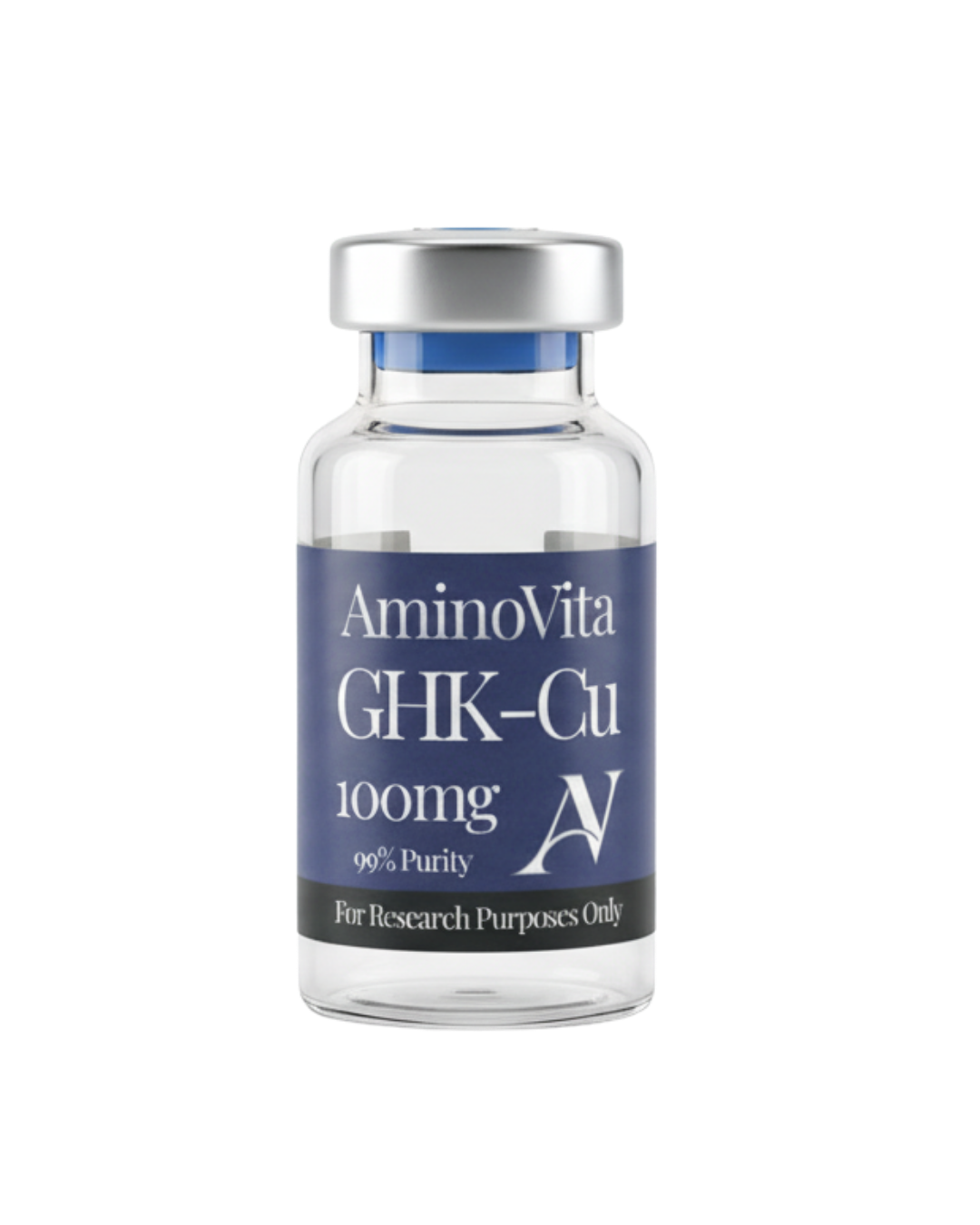
AminoVita Research Compound
$34.99
99%+ purity · Third-party tested · 100 mg
View ProductSubscribe & Save 10% — Free shipping on every order
Further Reading
Mechanism Deep Dive
How a simple tripeptide-copper complex became one of the most studied compounds in aging and regenerative research.
Wellness Science
The molecular markers of accelerated aging and what research says about resetting the clock at the gene expression level.
FAQ
GHK-Cu activates transcription factors — master switches that each control hundreds of downstream genes. By activating a handful of these master regulators (particularly Nrf2), the tripeptide's effects cascade throughout the genome. It's like flipping a few circuit breakers that each control an entire floor of a building.
GHK-Cu levels in blood plasma drop from about 200 ng/mL at age 20 to roughly 80 ng/mL by age 60. The cause isn't fully understood but likely involves decreased synthesis and increased degradation. This decline correlates with many aging markers — reduced collagen, increased inflammation, impaired wound healing.
Copper is essential for the function of key enzymes including superoxide dismutase (antioxidant), lysyl oxidase (collagen cross-linking), and cytochrome c oxidase (energy production). GHK acts as a copper shuttle, delivering this essential mineral directly to cells that need it for repair and defense functions.
No. While cosmetic applications popularized GHK-Cu, research extends to wound healing, bone regeneration, lung tissue repair, neuroprotection, and systemic anti-inflammatory effects. Its gene modulation is body-wide, not skin-specific. The cosmetic industry simply adopted it first because skin is the most visible tissue.
Not sure where to start? Browse compounds by research goal and find the right combination for your objectives.
Browse CatalogFor in-vitro research use only. Not for human consumption. The information on this page is for educational purposes only and does not constitute medical advice or a recommendation for human use. No claims are made regarding the diagnosis, studyment, is studied in, or prevention of any condition.